The word "computer network" may be familiar to our ears, since almost every day we involve computer networks in our work. Computer network is a system consisting of two or more computers connected to each other through transmission media or communication media so that they can share data, applications or share computer hardware.
The term computer network itself can also be interpreted as a collection of a number of communication terminals consisting of two or more computers connected to each other. The purpose of building a computer network is that information / data transmitter (transmitter) can get to the receiver (receiver) with precise and accurate.
The term computer network itself can also be interpreted as a collection of a number of communication terminals consisting of two or more computers connected to each other. The purpose of building a computer network is that information / data transmitter (transmitter) can get to the receiver (receiver) with precise and accurate.

Computer network allows users to communicate with each other easily. In addition, the role of computer networks is needed to integrate data between client computers so that obtained a relevant data.
COMPUTER NETWORK BENEFITS
Talk about the benefits of computer networking. There are many benefits of computer networks, among others :
- With a computer network, we can access the files we have as well as files of others who have been disseminated through a network, such as the Internet network.
- Through computer network, we can make the process of sending data quickly and efficiently.
- JComputer rendering helps one connect with others from different countries easily.
- In addition, users can also send text, images, audio, or video in real time with the help of computer networks.
- We can access news or information very easily through the internet because the Internet is one example of computer networks.
- Suppose that in an office requires a printer, we do not need to buy a printer with a number of computers contained in the office. We just buy one printer only for use by all office employees with the help of computer network.
TYPES OF COMPUTER NETWORKS
Generally, computer networks are grouped into 5 categories, ie based on geographical reach, distribution of information resources / data, data transmission media, the role and relationship of each computer in processing data, and based on the type of topology used. Here's the full description :
A. BASED ON GEOGRAPHICAL RANGE
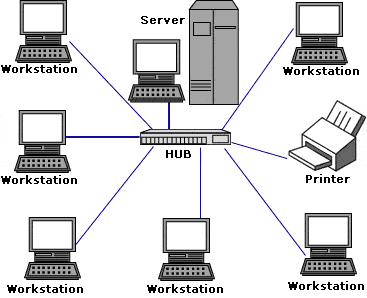
A simple network LAN scheme
1. LAN
Local Area Network or often abbreviated with the LAN is a network that covers only a small area, such as cafe, office, or school. Generally wide area LAN network not far from 1 sq. Km.
Usually LAN networks use IEEE 802.3 Ethernet technology that has data transfer rates of about 10, 100, even 1000 MB / s. In addition to using Ethernet technology, not a few also use wireless technology such as Wi-fi for LAN networks.
Usually LAN networks use IEEE 802.3 Ethernet technology that has data transfer rates of about 10, 100, even 1000 MB / s. In addition to using Ethernet technology, not a few also use wireless technology such as Wi-fi for LAN networks.
2. MAN
Metropolitan Area Network or MAN is a network that includes a city with high data transfer rates. In a way, the MAN network is a combination of several LAN networks.
Jangakauan of MAN network ranges from 10 to 50 km. MAN only has one or two cables and is not equipped with switching elements that serve to make the design more simple.
Jangakauan of MAN network ranges from 10 to 50 km. MAN only has one or two cables and is not equipped with switching elements that serve to make the design more simple.
3. WAN
Wide Area Network or WAN is a network that covers a wide geographical area, such as a country and even a continent. WANs are generally used to connect two or more local networks so users can communicate with other users even if they are in different locations.
B. BASED ON DISTRIBUTION OF SOURCE OF INFORMATION / DATA

Networks are centralized and distributed
1. Centralized Network
The meaning of a centralized network is a network consisting of client computers and server computers where the client computer served as an intermediary in accessing the source information / data coming from the server computer.
In a centralized network, there is the term dumb terminal, which does not have a data processing device.
In a centralized network, there is the term dumb terminal, which does not have a data processing device.
2. Distributed Networks
This network is the result of a combination of several centralized networks that allow multiple computer servers and clients that are connected to form a particular network system.
C. BASED ON DATA TRANSMISSION MEDIA USED

UTP cable, one of the media used on wired network
1. Wired Network (Wired Network)
The data transmission medium used in this network is a cable. The cable is used to connect one computer to another computer to be able to exchange information / data or connected to the internet. One of the transmission medium used in wired network is UTP cable.
2. Jaringan Nirkabel (Wireless Network)
In this network required electromagnetic waves as data transmission medium. Unlike wired networks, this network does not use cables to exchange information / data with other computers but uses electromagnetic waves to transmit information / data signals between computers to one another. Wireless adapter, one of the transmission medium used in wireless network.
D. BASED ON ROLE AND COMPUTER RELATIONSHIPS IN PROCESSING DATA


Model client-server
1. Client-Server Network
This network consists of one or more server computers and client computers. It usually consists of one server computer and several client computers. The server computer is in charge of providing data resources, while the client computer can only use the data resources.
2. Peer to Peer Network
In this network, each computer, be it server computer or client computer has the same position. Thus, the server computer can be a client computer, and otherwise the client computer can also be a server computer.
E. BASED ON NETWORK TOPOLOGY USED

One type of topology (topologi bus)
Computer network topology is a form / network structure that connects one computer to another. For a more detailed discussion of network topology, please read the article on the various topology of computer network I have ever written before.
So much for articles on understanding, benefits and various computer networks. Hopefully my short article is useful and easy to understand.
So much for articles on understanding, benefits and various computer networks. Hopefully my short article is useful and easy to understand.

Tidak ada komentar:
Posting Komentar